UNESCO — Dive into Heritage: world heritage in VR and at your fingertips
For the launch of the “Dive into Heritage” platform, UNESCO wanted an exhibition where you handle world heritage instead of looking at it. We delivered the two installations that make that possible.
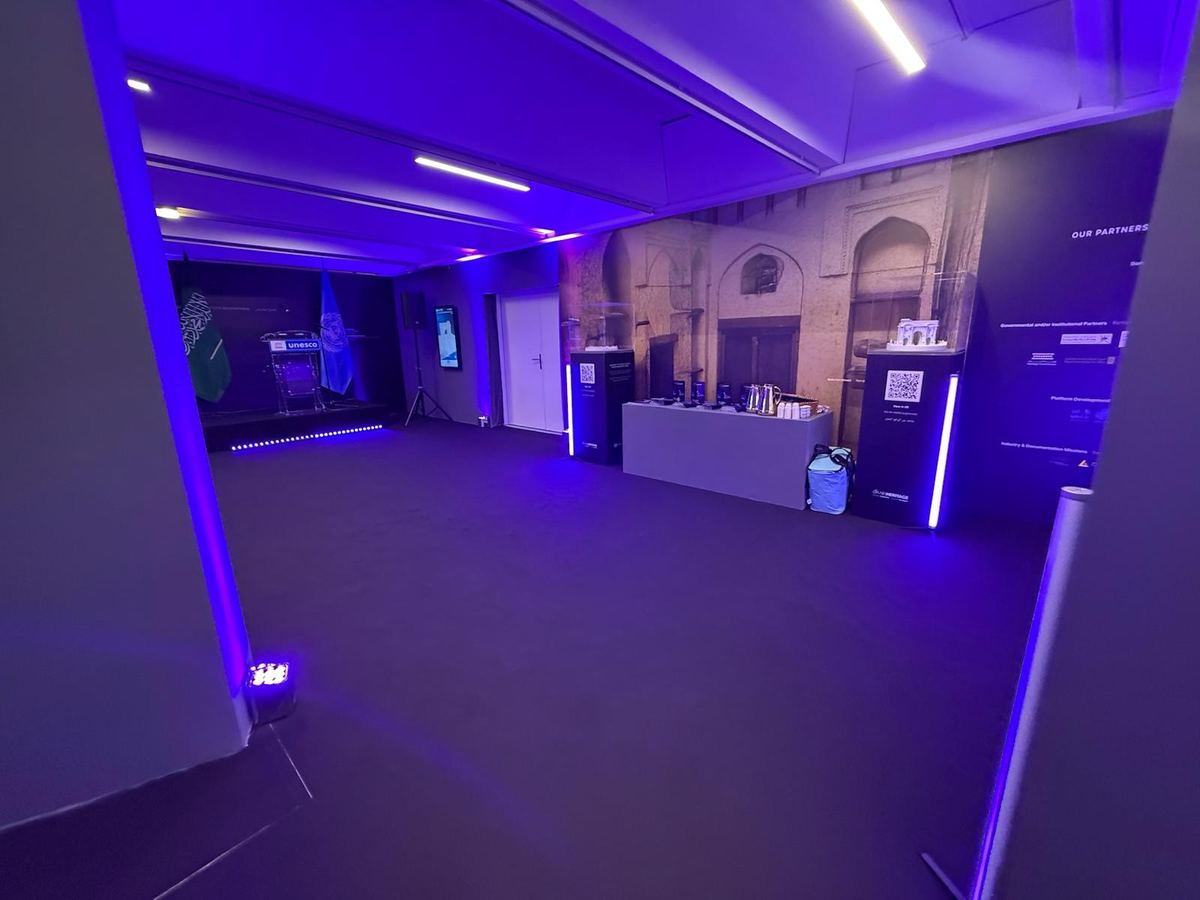
From 6 to 16 July 2025, UNESCO staged an exhibition in Paris alongside the 47th session of the World Heritage Committee. It marked the official launch of “Dive into Heritage”, an online platform for exploring World Heritage sites and the intangible cultural heritage attached to them.
A platform demonstrates badly on a conference screen. It had to be made touchable: someone crossing the room in ten minutes had to leave having seen a World Heritage site, not a screenshot of a website.
Decorama, the GL Events subsidiary specialising in event fit-out, was running the project. The tender had three lots: the structure of the exhibition, the audiovisual equipment, and the creation of 3D content. We worked on that third lot.
360° photos, turned into a place
UNESCO had 360° footage of its sites, in raw form. Our first job was to place it inside a virtual reality world: to build around those images the space, the markers and the sequences that make you move through them instead of simply looking at them.
The difference is not technical, it is a difference in kind. A 360° photo shown as it is remains an image you turn your head inside. Staged, with an order, stopping points and a way out, it becomes a place you go to — and that is what stays with you when you take the headset off.
Two headsets were set up in the room, free to try. No training, no instructions: pick it up, look, put it down.
An interface for handling heritage
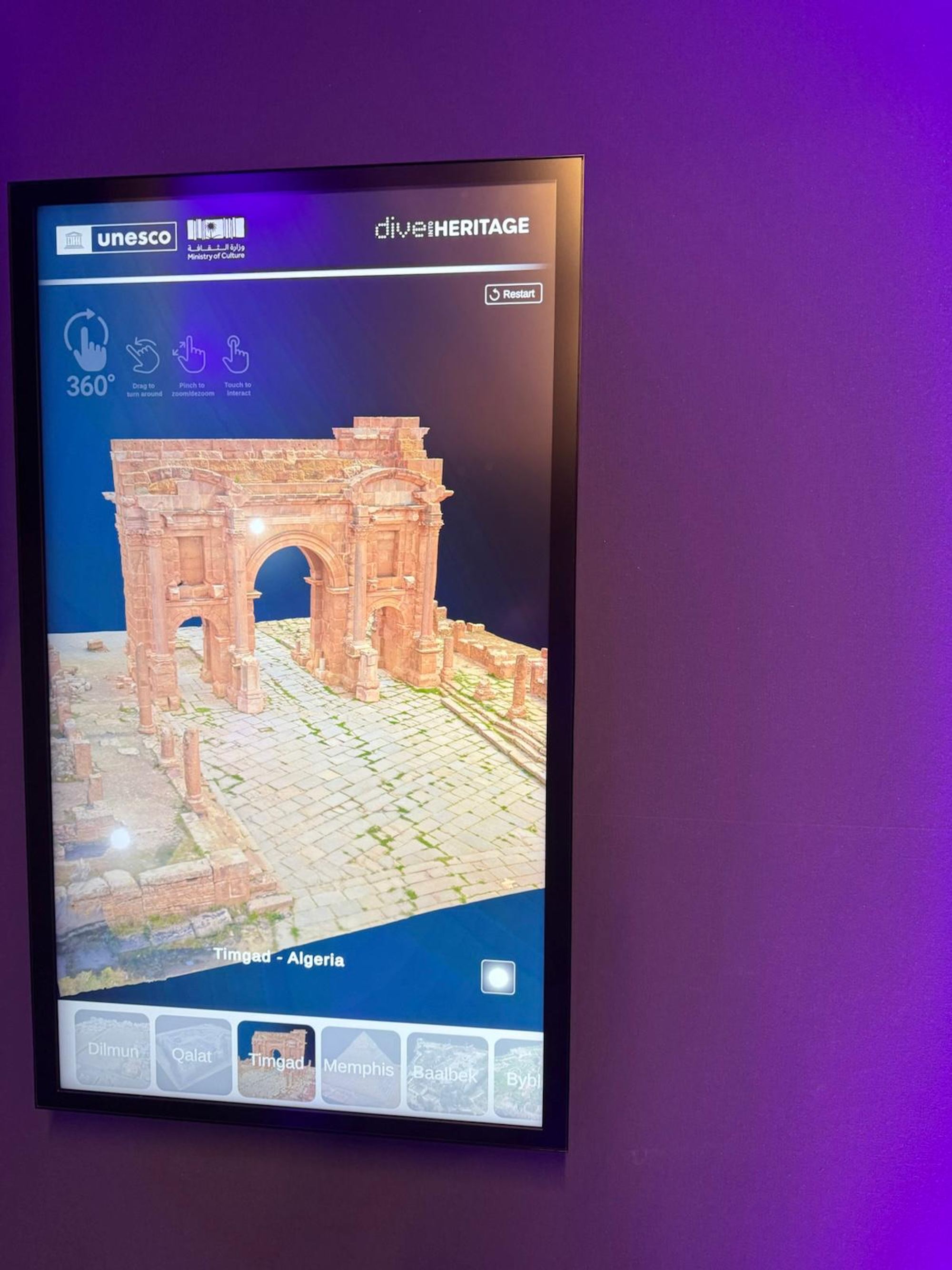
The second piece is a touch interface, on a vertical screen. It gives access to eight World Heritage sites across seven countries: Dilmun and Qal’at al-Bahrain, Memphis in Egypt, Baalbek and Byblos in Lebanon, Leptis Magna in Libya, Bahla Fort in Oman, and the arch of Timgad in Algeria.
Four gestures, announced at the top of the screen and nowhere else: turn the site through 360°, pinch to move in or out, touch a point to open it. You move from one site to the next through a row of thumbnails along the bottom. The 3D models come from UNESCO; what is ours is what lets you handle them.
And there is a Restart button, top right. That detail says everything about the rest: an exhibition interface does not behave like a website. It has to explain itself without a manual, and return to its starting state on its own between two visitors. Nobody discovers it with someone standing by to present it — it stands up alone, or it is useless.
Two weeks, and the opening does not move
Between the start of the project and delivery, there were two weeks. An exhibition opening date is not negotiable: on 6 July the room opened, with us or without us.
Two 2D/3D artists and a developer worked in parallel on the two installations, from the data UNESCO supplied. We were also on site during the run — because an interactive installation in an exhibition is not delivered, it is looked after.